Wednesday, March 25, 2015

LibDems bring Tories on board in gender pay gap issue

Jo Swinson* on Liberal Democrat Voice reports:

In the final days of this Government Lib Dems are still delivering our agenda against the odds, and against Conservative obstruction.
Under the coalition government the gender pay gap had fallen to its lowest level, at just under 20% – but this is still 19.1% too high. Despite our high levels of women’s employment the UK has the 8th highest gender pay gap in the EU.
Not only is the gender pay gap socially wrong in modern society, but economically it’s nonsensical not to reward our most talented female employees properly. We should value the contribution of women and men in the workplace equally, so our goal has to be eliminating the pay gap completely.
As a Business Minister and Minister for Women, I have worked very hard to persuade my Coalition colleagues of the virtues of tough action to tackle this long-term inequality. Their traditional resistance makes it all the more remarkable that Nick Clegg has, in the last few weeks of our term, secured a government amendment that guarantees all large businesses will have to publish the difference between average pay for their male and female staff. So today (Tuesday) I will proudly vote for our party’s manifesto commitment – for large companies to publish the difference in average pay between male and female employees – to become law.
This is a significant win for women, and a political win for Liberal Democrats in Government. Amendments to the Small Business Bill, [approved in the House of Commons yesterday (Tuesday),] will fast-track our manifesto plans for gender pay transparency within the next 12 months. This will mean large companies – over 250 employees – will be legally required to publish the average pay of their male and female staff. It is our intention to create pressure from staff and customers to account for and close any pay gap that exists between men and women in large businesses. Women will know whether they are being properly rewarded for their endeavours: a situation that is good for competitive businesses and good for the economy.
As readers of Lib Dem Voice will know, we have argued for mandatory pay transparency since before the coalition was formed. We were the first major political party to commit to enforcing gender pay transparency by law. Labour might try to claim now that they would have done this in 2010 but actually their proposal was for voluntary publication for four years. This was something our champion for women, Lynne Featherstone objected to at the time – arguing against Labour’s delay that “pay audits are necessary and must be mandatory. We cannot wait another four years… voluntary pay audits are like waiting for Godot.”
In the wake of entrenched Conservative opposition, and in the context of Labour’s commitments while in government, we had to agree to try a voluntary approach first.  We did so only on the condition that the decision would remain under review, and if this approach did not lead to more companies publishing the difference in pay between men and women, mandatory reporting would be introduced for large companies. During our time in government just five companies have chosen to publish their gender pay gap voluntarily.  While I take my hat off to those who do – this is just not good enough.
Of course, the gender pay gap is not exactly an issue that the Conservative Party gets out of bed for. They were content to kick this issue into the long grass time and time again. Nick and I have made increasingly urgent appeals to our Conservative colleagues to address this. Which is why, today I am proud that we will go further than I expected. By securing a government amendment, Nick Clegg has successfully ensured that ministers on the government payroll will vote in favour of gender pay transparency, despite the Conservatives’ consistent efforts to block the proposals over the life of the coalition.
I could speculate about why the Tories have caved just weeks before the election – maybe the International Women’s Day celebrations caught the PM in a jovial mood? Or perhaps he feared that history (or the voters) would judge him for being on the wrong side of this argument.  It may be that with some help from the Liberal Democrats, he simply read the political runes and didn’t want to countenance any risk to the successful passage of the Small Business Bill as the firm deadline of Parliament’s dissolution approached. Liberal Democrats can be proud that we have been the drivers of reforms to modernise the workplace to give women a fairer chance to get to the top of the career ladder. By extending flexible working to all employees, introducing Shared Parental Leave and revolutionising childcare, we are ensuring that there is greater equality at home and at work.
We can also be proud that – thanks to our term of stability in government – there are more women in work than ever before and women’s gross weekly earnings have increased between 2013 and 2014. Additionally we have banned pay secrecy clauses and introduced mandatory pay audits for companies that lose equal pay claims. The Government is also committed to tackling occupational segregation, and the outdated view that certain jobs are for “men-only”. Only 13% of engineers in this country are women – substantially lower than other European countries like Latvia, Sweden and Bulgaria. Through initiatives like “Your Life” we are encouraging young girls to get into STEM-related careers.
We have achieved a lot, but there is still much more to do. Equal pay and better gender representation in business is good for the economy as well as helping to create a fairer society. So any future coalition that contains Liberal Democrats will ensure this remains front and centre of our efforts in government.

* Jo Swinson is the Liberal Democrat MP for East Dunbartonshire and is a Minister in hte Department Business, Innovation and Skills and Equalities Minister


Tuesday, March 24, 2015

Minimum-wage dodgers named and shamed

The Department for Business, Innovation and Skills has issued another list of those employers, including some High Street brands, who have illegally paid some staff less than the minimum wage. This latest round brings the total number of companies named and shamed under the new regime to 210 employers, with total arrears of over £635,000 and total penalties of over £248,000.

Business Minister, Liberal Democrat Jo Swinson said:

There’s no excuse for companies that don’t pay staff the wages they’re entitled to – whether by wilfully breaking the law, or making irresponsible mistakes.
The government is protecting workers by cracking down on employers who ignore minimum wage rules. In addition to naming and shaming, we’ve increased the penalty fines and boosted the resources available to investigate non-compliance.

Tuesday, March 17, 2015

Seven-year record rise in minimum wage

Wales Online reports:

The national minimum wage will go up by 20p an hour from October.

It will be the biggest real-terms rise in seven years with 1.4 million low paid workers set to benefit from the 3% hike while rates for younger workers and apprentices will also go up.

The rates were recommended by the Low Pay Commission.

[Liberal Democrat] Business Secretary Vince Cable is planning to launch a national minimum wage accelerator - an online tool which will make it easier to compare rates of pay across regions, sectors and occupations.

It will take data from the annual survey of hours and earnings and display information about pay so that people are able to compare wages with others in their sector and region.

Mr Cable hopes that by having the facts, people will be empowered to discuss pay with their employers and businesses will be encouraged to consider whether they can increase rates.

The Government is also launching a consultation with businesses on the future minimum wage for apprentices.


It is predicted that inflation as measured by CPI will fall below 1% this year. The headline increases are in line with the recommendations from the Low Pay Commission, but for apprentices the coalition government went further. The recommendation was for a mere 7p increase rather than the 57p increase which will actually be introduced.

Monday, March 16, 2015

More from Liverpool federal conference

Freedom of expression:
http://youtu.be/o9rM6BKAGss

The Leader's speech:
http://www.libdems.org.uk/nick-clegg-speech-to-spring-conference-2015

Tuesday, March 10, 2015

A blow for equal earnings

An amendment to the Small Business Bill being debated in the House of Lords next week would change the law to force firms with more than 250 staff to declare how much they pay men and women.

Jenny Willott, Lib Dem MP for Cardiff Central, said: “Real equality means fair pay. Women on average are paid 20% less than men, and are less likely to be in a leadership role. That frankly isn’t good enough.
“I have been pushing within Government to see this change – companies need to be held to account for how much they pay their male and female employees. I’m delighted that this will now be brought in and I hope it will make a real difference to the gap in pay between men and women.
“Let us be in no doubt, this wouldn’t have happened if it weren’t for the Liberal Democrats. The Tories have resisted these changes, but we have won the argument.”
Deputy Prime Minister Nick Clegg said: “We can’t wait and we can’t dither. We need to sort this out now. Jo Swinson, Jenny Willott and I have pushed for this to happen within government for a long time. Finally, we are now in a position for the government to vote through our party’s manifesto commitment for large companies to publish the difference in average pay between male and female employees.”

Sunday, March 08, 2015

Things LibDems have stopped Tories doing


  • Inheritance tax cuts for millionaires 
  • Scrapping help with housing costs for young people
  • Weakening arrest warrants for people who have fled overseas
  • Firing workers at will, without any reasons given
  • Regional pay penalising public sector workers outside London and the South East 
  • The Snoopers’ Charter
  • Ditching the Human Rights Act
  • Weakening the protections in the Equalities Act
  • Renewing Trident in this Parliament
  • Cutting investment in green energy
  • Nation-wide immigration checks on all new tenants and lodgers


Thanks to Mark Pack. His full list (including England-only measures) is here.


Friday, March 06, 2015

Debates

  • Nick Clegg will step in to the head-to-head debate with Ed Miliband to defend the Government’s record if David Cameron will not.
  • By proposing to hold the debate before the Tory manifesto is published, the public will not be able to see David Cameron grilled on his plans for Britain.
  • Liberal Democrats are not afraid to debate our record or our manifesto. We are proud that we have helped rescue the British economy and ensured the recovery has been done fairly.
  • Nick Clegg is passionate about anchoring these debates into the democratic process. If this means taking part in a “seven-sided 90 minute bite size squabble fest”, so be it.
  • It is not right for one party and one man to hold the debates to ransom. They are a right of the British people. Why should the Conservatives hold a veto over our democratic process?
Liberal Democrat General Election Chair Paddy Ashdown said on the Today programme:
“I'm told that Downing Street is now depending on the Liberal Democrats to say no. Well, I've got bad news for them. We're not going to.
"I hope the broadcasters stand firm but I need to be very clear that even if it is done in the fashion that the Prime Minister demands - and why on earth should he be able to veto the democratic debate? - we will still be there.
“If it is the case that there's a two-headed debate and Mr Miliband turns up and the Prime Minister will not defend the record of the Government, then Nick Clegg will be very happy to.
“What he is proposing is not just a ludicrous, seven-sided, bite-sized squabble fest but actually he is proposing it takes place before the Conservative manifesto is published.
“If Mr Cameron hasn't got the guts to stand up and defend this government's record then Nick Clegg will do so."

Thursday, March 05, 2015

Drugs reform

The Deputy Prime Minister confirmed today that the Liberal Democrat manifesto will contain the most far-reaching drug reform policies ever put forward by a major political party.
Liberal Democrat leader Nick Clegg made the commitment at an event alongside entrepreneur Richard Branson, a member of the Global Commission on Drug Policy.
The manifesto will include commitments to:
  • Adopt the approach used in Portugal, where those arrested for possession of drugs for personal use are diverted into treatment, education or civil penalties that do not attract a criminal record.
  • Legislate to end the use of imprisonment for possession of drugs for personal use, diverting resources towards tackling organised drug crime instead, as a first step towards reforming the system.
  • Continue to apply severe penalties to those who manufacture, import or deal in illegal drugs, and clamp down on those who produce and sell unregulated chemical highs.
  • Establish a review to assess the effectiveness of the cannabis legalisation experiments in the United States and Uruguay, in relation to public health and criminal activity.
  • Legislate to make the Advisory Council on the Misuse of Drugs independent in setting the classification of drugs, while remaining accountable to Parliament and the wider public.
  • Enable doctors to prescribe cannabis for medicinal use.
  • Put the Department of Health rather than the Home Office in charge of drug policy.

Nick Clegg said:
 “If you’re anti-drugs, as I am, then you have a responsibility to look at the evidence of what actually works to reduce drug harm."At the moment, the level of harm to individuals and communities – here and around the world – is still unacceptably high. We need to get a grip on this problem. So, if you’re anti-drugs, you should be pro-reform.
“What we now need is brave political leadership to openly acknowledge that new ways of controlling illegal drug markets and discouraging use are required.
“So, my challenge today for politicians, the press and the public is to accept the overwhelming evidence that things are not working, that politicians are letting down the victims of the drugs trade by failing to engage with the evidence.
“Talking tough while acting weak may be tempting, but it no longer fools anyone.  It is time to commit to a radically smarter approach to tackle this problem head-on.”

Monday, February 23, 2015

Danger from metal thefts reduced by LibDems in coalition

Local Lib Dems have welcomed the news that scrap metal thefts have fallen by a third in the past year – combatting unscrupulous thieves targeting churches, desecrating war memorials and causing disruption by stealing electric cables and metal from railway lines.

Latest figures show there were 40,680 metal thefts in England and Wales in 2013/14 – down from 59,788 in the previous 12 months.

The decline in metal thefts – which cost the economy around £770 million a year – follows the new Scrap Metal Dealers Act which came into force in October 2013 alongside a range of other measures to tackle the crime. Liberal Democrat MPs and Lib Dem ministers in Government called for these tough measures to become law, as did the Local Government Association.

Under the law, every scrap metal dealer had to obtain a licence from their local council to trade. Town halls have been able to refuse or revoke licences, have new powers of entry and inspection and the ability to shut down rogue dealers.

It is also now illegal for anyone to buy or sell scrap metal with cash while traders have to keep records of names and addresses of scrap metal suppliers. This is increasing traceability for all transactions and making it more difficult for thieves to sell stolen metal to scrapyards.

Councils across the country have been assisting the police to prosecute unlicensed traders and shut down scrap metal businesses that break the law.

Other figures include:

Infrastructure-related metal thefts – including from railway lines, church roofs and machinery – dropped by 41 per cent in the past year;

The number of metal theft offences recorded each month more than halved from 6,609 in April 2012 to under 3,000 in March 2014.

Frank Little, secretary of Neath Liberal Democrats, said: “When I was a councillor, I saw at first hand the danger caused to sheltered housing by the theft of gas pipework.

“The scourge of metal theft costs the country hundreds of millions of pounds a year.

“It sees trains disrupted, precious memorials desecrated, church and library roofs vandalised, children’s playground equipment targeted and road signs stolen.

“Such a significant drop in metal thefts is excellent news for communities who have suffered from the chaos, disruption and heartache caused by unscrupulous metal thieves.

“Lib Dems had been calling for years for new laws to help regulate the scrap metal industry in order to make it more difficult for thieves and it is great to see that we made this happen in Government.

“However, there is still much to do. The Local Government Association is urging the Government to continue investing in council and police efforts to co-ordinate enforcement action and gather intelligence to target and disrupt criminal networks and keep up the pressure on metal thieves. Local Liberal Democrats will be asking Neath Port Talbot county borough council what further work they are planning to do to enforce this law”.

NB The Scrap Metal Dealers Act 2013 replaced the 1964 Scrap Metal Dealers Act and was passed in Parliament in February 2013

What the hell have the LibDems done in coalition?

Thursday, February 12, 2015

A taste of the Welsh Liberal Democrat manifesto for May

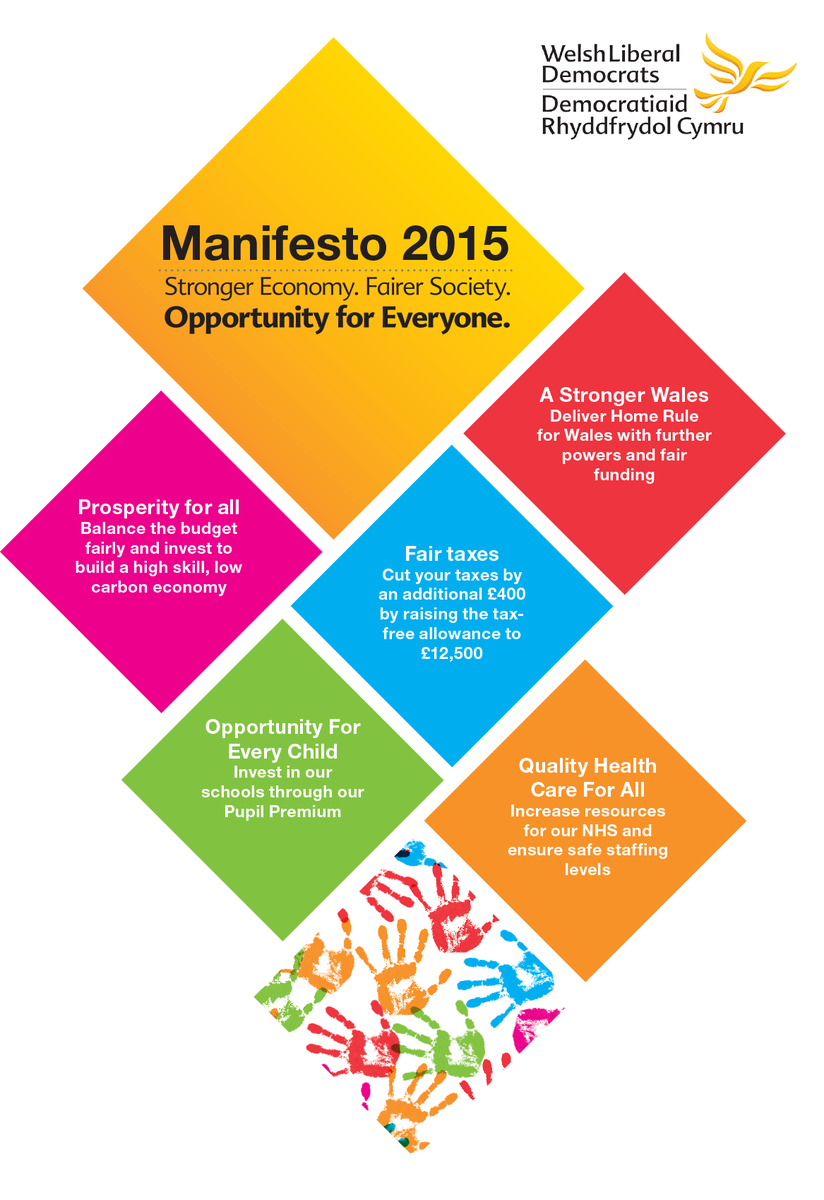
We’ll deliver a stronger Wales, with more powers, home rule and fair funding.
We’ve already ensured that the Pupil Premium, which delivers extra money to help disadvantaged kids in school, has been implemented in Wales and we’ll deliver continued investment. On health the priority is more resources and safe staffing levels, consistent with Kirsty Williams’ Assembly Bill to put staffing levels on a statutory footing.

Monday, February 02, 2015

Labour woos rich friends with tuition fee policy

Councillor Iain Roberts, Deputy Leader on Stockport Metropolitan Borough Council writes:

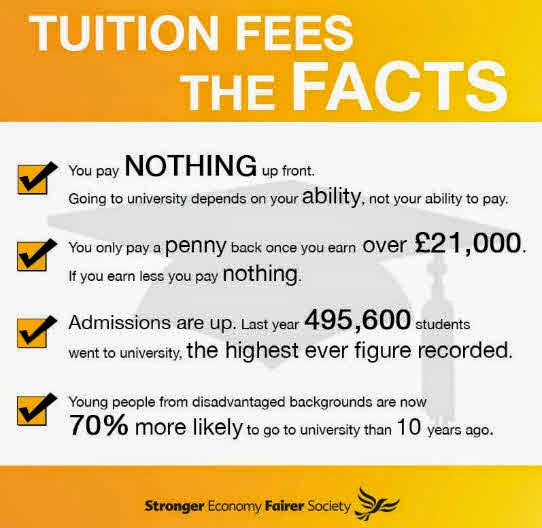
The Coalition’s Tuition Fees policy cut the cost of university for poorer graduates (but increased it substantially for the wealthiest) and has seen not only record numbers going to university, but also the highest ever number of young people from poorer backgrounds signing up. And yes, not the Lib Dems finest hour with the pledge and all that – no doubt commentators below the line will find new and interesting things to say on that topic that no-one’s thought of in the last four-and-a-bit years.

But let’s take a look at what Labour’s proposals would actually mean. First, as university vice-chancellors have been quick to point out, it would create a funding black hole – they claim £10 billion over five years.

Second, the people who would benefit are rich graduates. The new fees system is a graduate tax in all but name. It is designed so lower-paid graduates never pay back anything like the full amount. The lowest paid won’t repay a penny and the bottom third pay back less than under the old Labour scheme. Cutting fees from £9,000 to £6,000 would make no difference to them at all – they were never going to repay even half the full amount, and they’ld carry on paying the same.

The people who would benefit are the wealthiest graduates – and the richer you are, the more you would save. If you graduate and become a high-paid banker who would have repaid the full loan plus interest, you get a nice big tax cut from Mr Miliband.

And who would pay for this tax cut for the rich? Labour has two choices. They could increase tax to cover it – making us all dip into our pockets. Or they could cut services – perhaps making further cuts to welfare to help those wealthy bankers. Labour has already promised to be “tougher than the Tories” on cutting the benefits bill.

Labour’s Tuition Fees proposal is a poorly thought-out, unfunded , headline-grabbing policy that would result in a tax-cut for wealthy graduates with either tax rises or cuts in services for the poor.

Friday, January 23, 2015

Broadcasters' proposal disadvantages Liberal Democrats

Caron Lindsay explains why the scheme adopted by BBC, Sky, ITV and Channel 4 for televised party leader debates during the general election campaign favours the other parties.

Nick Clegg will have approximately 18 minutes (over two debates)  to defend a record of 5 years in government, while Cameron will have an hour more. That’s simply not fair to either the Liberal Democrats or the public.
Can you imagine how tortuous it is going to be to watch Cameron and Miliband debate on their own for 2 hours? For a clue, watch Prime Minister’s Questions. I can’t imagine either of them rising to the occasion. Cameron was very poor in 2010 and Miliband is really not suited to that kind of environment. Giving them the stage to themselves, though, allows them to set the agenda. Cameron will likely spend half the time passing off our policies as his own and the other half telling the country we’re an untamed bunch of hippies who are soft on Europe and terrorists. Miliband will be trying to equate us with the Tories and nobody will be there to make our case.


Thursday, January 22, 2015

Urgent call from LD4SOS

Lib Dem MPs have reacted quickly and well to an appalling Home Office
decision to make all asylum seekers, wherever they live in the UK, who
have been refused leave to remain and are appealing, to have to travel to
Liverpool to submit fresh evidence. The detail is in this pdf.

Please write to your MP (Hywel Francis for Aberavon or Peter Hain for Neath) to sign the EDM below, and ask organisations that you know of who will be concerned of to write to their MP and circulate.

LD4SOS have worked hard this week and there is now an Early Day Motion,
tabled by Julian Huppert MP and already signed by MPs of all parties,
urging the Home office to change the rules on submitting new evidence in
asylum cases.  The Early Day Motion is set out in:
http://www.parliament.uk/edm/2014-15/714

Sarah Teather MP has put down a parliamentary question as follows :
“To ask the Secretary of State for the Home Department, for what reasons
her Department decided that further submissions on asylum and human rights
cases must be made in person in Liverpool; with which bodies her
Department consulted before making this decision; and what assistance her
Department will provide to help individuals travel to Liverpool to make
such submissions.”

There is an article in this morning’s Independent here :
http://www.independent.co.uk/incoming/asylum-seekers-set-to-be-forced-to-tr
avel-hundreds-of-miles-to-submit-documents-to-home-office-9993667.html

LD4SOS have written two articles here :
http://www.ld4sos.org.uk/archives/349
http://www.ld4sos.org.uk/archives/351


Thursday, January 15, 2015

Welsh LibDems aim to boost Welsh NHS

Wales could be the first UK country to ensure 'enough nurses'.

Kirsty Williams, the Welsh Liberal Democrat leader, is to present her 'More Nurses' Bill to the Health and Social Care Committee today.

She said: "Safe nursing levels are a bedrock for effective care. Nurses provide round the clock care for patients, and work in every kind of healthcare setting. Quite simply, nurse staffing levels are too important to be left to 'guidance'.

"Making safe nursing levels a statutory responsibility will provide a legislative basis for patients and staff to challenge poor levels of nurse staffing."

Wednesday, December 31, 2014

Happy New Year!

Aberavon and Neath Liberal Democrats wish all our readers a happy and prosperous 2015.

As the national membership increases and we continue to make progress in council by-elections, we as a party can look forward to a better outcome in the big elections to come than the BBC and some elements of the print media are predicting.


Tuesday, December 16, 2014

Liberal Democrat position on devolution in England

In the wake of the Scottish Referendum result and the Smith Commission process it is right that Government and all political parties should consider the implications for England, and indeed the rest of the United Kingdom.

The Liberal Democrats believe it is now time to set out a reform programme to devolve more powers within England and to address the so called “West Lothian Question.”

Aberavon and Neath Liberal Democrats congratulate the parties in Wales in agreeing on a way forward for devolution in Wales and deprecate the position of the Labour Party in Westminster in not contributing to the Command Paper launched in the Commons today.

The Liberal Democrat party has from its inception been a federal organisation and thus has long experience in its own deliberations in discriminating between regional, national and state interests. The party's contribution to the government's Command Paper may be read at https://d3n8a8pro7vhmx.cloudfront.net/libdems/pages/7092/attachments/original/1418725024/LD_England_Command_Paper.pdf.


Thursday, November 27, 2014

Welsh NHS absenteeism rising

Sickness absence levels are on the rise in the Welsh NHS, according to latest statistics, reports WalesOnline.

The Welsh Ambulance NHS Trust fared the worst after 7.8% of contracted hours were lost due to staff absences

Welsh Liberal Democrats leader Kirsty Williams has called for the Welsh Government to do more to support “overworked” NHS staff.

She said: “Paramedics do incredibly stressful work around the clock and sickness levels have been high for a long time.

“I can only imagine how demoralising it must be to be doing such an important job but not getting the appropriate support from the Welsh Government.

“Our ambulance service is hugely overstretched and staff are not given the resources they need to serve the people of Wales.

“When I’m talking to nurses, the same issues keep coming up – they feel stressed and over-worked.

“That’s why so many of them are backing my plan for more nurses on our wards, to provide safe nurse staffing levels and reduce dependency on agency nurses as well as increasing staff morale.”


Friday, November 14, 2014

Candidate for Aberavon


Aberavon Liberal Democrats have re-selected Helen Ceri Clarke, who stood for the party in the Welsh
General Election, as their candidate for the Westminster election in May 2015.


Tuesday, November 11, 2014

Neath candidate chosen


Neath Liberal Democrats have selected Clare Bentley as their prospective candidate for the UK general election in May 2015. Clare is an administrator, who will shortly be moving from Swansea to Coed Darcy.

Monday, November 03, 2014

Peter Black slams Labour housing record

Wales Online reports that more than 2,000 people in Wales have been on a housing waiting list for more than a decade. Nearly 9,000 people have been waiting for more than five years, the figures suggest

Peter Black, Liberal Democrat AM for South Wales West  and the party's housing spokesman, responds:

“These figures are a stark reminder just how bad the housing shortage is here in Wales. Fifteen years of Welsh Labour in Government has led to literally thousands of people waiting over a decade for a home. It is simply unacceptable that so many people here in Wales have had to put their life on hold until a home is available to them.

“Due to major failings with our NHS and our schools, it often goes unnoticed quite how badly Labour has let people down with regards to housing. Over a decade of inaction has led to an acute housing shortage.

“For too long the Welsh Labour Government has taken a haphazard approach to housing targets. The Welsh Liberal Democrats believe the Government’s Housing Act should have included a statutory duty for Government Ministers to set termly targets for the supply of new affordable homes.

“After each Assembly election, a new target must be set, with a duty to review it and report back annually. This issue is so important that these targets should be enshrined in law.

“Many of us are aware of derelict and empty homes in or near our neighbourhood. Not only are they a blight on our communities, but they also, frankly, are a waste of living space. It’s time the Welsh Government developed an empty homes strategy so we can finally put these buildings back into use.”

Monday, October 27, 2014

Other People's Money

A Freedom Of Information response reveals that the Welsh Government paid London-based engineering consultancy Arup more than £6.3m from 2010-2011 to advise on the controversial project to divert the M4 round Newport through a SSSI.

Eluned Parrott, the Welsh Liberal Democrat transport spokeswoman said the “billion pound mistake” would see Welsh finances “tied up for a generation”.

“It looks increasingly likely that these plans are doomed, so it's time for the Welsh Government to stop wasting public money on it,” she said.

“It’s particularly insulting for taxpayers that not only has £6m already been spent drawing up plans for this road since 2011, but to add insult to injury, the Welsh Labour Government has evasively refused to publish the full conclusions of this expensive, yet flawed, consultation.

“In budget negotiations, the Welsh Lib Dems agreed that no construction of the M4 relief road will start before the next Assembly elections, and that no construction contract would be awarded.

“The deal means that no irreversible decisions on the M4 can be taken before then, but given the number and cost of the hurdles that need to be overcome, and the enormous environmental damage it would do, surely the best idea would be to shelve it, permanently, now.”

Tuesday, October 21, 2014

Labour government resists calls for NHS investigation

The first minister has dismissed calls for an inquiry into the running of the NHS in Wales.

Welsh Liberal Democrat leader Kirsty Williams repeated her call for an all-party commission, saying: "Labour's-running of the NHS in Wales is nothing short of a national scandal."

She went on:  "it is the Labour-led Welsh Government’s fault that waiting times are increasing and they are not caused by devolution.

She said: “Nurses in Wales have more patients to care for than any other part of the UK. That is why the Welsh Liberal Democrats are campaigning to introduce safe staff nursing levels on our wards to ensure safe and compassionate care in all hospitals. NHS staff work tirelessly, but like patients, they are being failed by the Welsh Labour Government.”

Wednesday, October 15, 2014

Welsh NHS waiting list


New figures reveal that nearly 1,400 patients waited more than a year for hospital treatment and that nine of them have been waiting for more than two years.

Kirsty Williams, leader of the Welsh Liberal Democrats said: “These figures are nothing short of a national disgrace. It is completely unacceptable that nearly 1,400 people are being forced to wait over a year for treatment.

“Month after month we see the Welsh Government’s 36 week target missed. However these figures show the problem is even worse than that. My concern is that the Welsh Labour Government seems entirely clueless on how to turn things around. Waiting lists are piling up and I see little sign of the situation improving.”

The Liberal Democrats have urged the Welsh Government to establish a commission to secure a historic and long-term plan for health and social care in Wales.

Kirsty Williams added: “A commission with cross-party, professional and patient representatives would be able to work together and deal with the strategic problems facing our NHS in Wales. By involving doctors, nurses and patients from the outset, we would ensure that the experiences of those using our frontline health services feed into the efforts to reform our NHS.

“Whether it is inadequate cancer care, poor ambulance response times or dire A&E waiting times, the Welsh Labour Government is failing to provide the health service that patients in Wales deserve.”

Saturday, September 06, 2014

Liberal Democrat social housing benefits policy

Liberal Democrat Party Headquarters has issued the following Q&A, following Andrew George MP's success in the House of Commons yesterday. His "Affordable Homes Bill" has cleared the major hurdle of a Second Reading, which means it can go on to detailed consideration in committee. Among other things, the Bill would practically abolish the iniquities of the coalition's Removal of the Spare Room Subsidy, the so-called Bedroom Tax. Mr George's Private Members Bill has the support of the Labour Opposition as well as the parliamentary Liberal Party.

Why are you doing this now?

We have been monitoring the introduction of the policy carefully. The results of the interim evaluation have now been published and they show some concerning findings such as that 57% of claimants reported cutting back on household essentials. We have protected the vulnerable so far but we now want to reform the policy to protect those people for the long term.

Why haven’t you implemented these changes in government?

We have protected vulnerable groups by providing hard cash for hard cases – £180m in Discretionary Housing Payments last year – not all of which has been spent by councils. We have been monitoring the introduction of the policy carefully and have recently received the interim results of the initial evaluation of the policy. These show that the policy has had an impact on disabled people who need a spare bedroom and we want to ensure that these people are exempted. We also want to ensure that those who have tried to downsize but have not been able to are not penalised. We will make the case to our coalition partners that the policy needs to be reformed.

The Tories don’t agree with you do they?


We will continue to make the case to our coalition partners that the policy needs to be reformed. If we do not reach agreement in this parliament we will commit to these reforms in our manifesto.

What about other groups who are affected (e.g. parents who don’t live with their children but have them to visit regularly)

There would still be a (more limited) pot of Discretionary Housing Payments available for hard cash to cover hard cases. It is already the case, however, that private sector tenants have to pay for a spare bedroom in this circumstance.

Not all disabled people will be covered by your policy?

We are exempting those disabled people who need a spare bedroom or those who live in specially adapted properties. Not all disabled people will need a spare bedroom. We will consult on the detailed guidance.

What about all the other housing benefit reforms? This change doesn’t go far enough.

Between 2000 and 2010 expenditure on Housing Benefit grew by around 50% in real terms. This is clearly unsustainable, particularly at a time when we need to reduce the deficit and build a stronger economy. That is why we have made reforms to the housing benefit system, but it is also why we are working to build more affordable homes. There are also still Discretionary Housing Payments available for vulnerable people.

You are penalising housing associations who can’t build more houses. That isn’t fair, and will mean that they have less funding to build more houses in future.

We recognise it is not fair for people to have a reduction in their housing benefit if they have tried to downsize but have not been offered an alternative property. We believe there needs to be a small incentive on housing associations and local authorities to offer people reasonable alternative accommodation, including encourage people to downsize in order to free up homes for those on housing waiting lists or those living in overcrowded accommodation. This will also be an incentive to look at ways some local authorities have tackled the problem. This includes opportunities to convert larger properties or to encourage house swaps or ‘rent a room’ schemes, which help to prevent homelessness, and encourage people to think about options for getting extra income.


Monday, August 11, 2014

Fair funding for Wales

After many years, Welsh Liberal Democrats have now convinced the federal party (currently in coalition with the Conservatives in Westminster) that the unfairness of the Barnett formula (named after a Labour Treasury minister), under which funding for Wales and Scotland is calculated, should be addressed.

Party leader Kirsty Williams writes:

 
I am pleased to announce today that we have secured our party’s commitment to overhaul the unfair funding system for Wales.  

Going into the General Election, we will pledge that Wales will have fairer funding for the next parliament, which could mean hundreds of millions of pounds extra coming into Wales. 

As we all know, under successive Labour and Tory Governments,  Wales has been underfunded for years.  The last major piece of work on this, the Holtham report, concluded that Wales was losing £300m a year.  That simply is not fair. 
Not only do we recognise that Wales is underfunded, but unlike the Tories, Labour and Plaid, we will actually do something about it. 

This announcement is about Wales getting a fairer deal and we believe this is the quickest and easiest way forward for that to happen.

In Government, we have a proud record of delivery for Wales and we are now the only party that has made a firm commitment to more funding for Wales. 

Once again, the Liberal Democrats are showing that we are the only party in Westminster that will make a positive difference for the people of Wales.


Tuesday, August 05, 2014

A firm but fair immigration system

Clegg: I’m a believer in the benefits of well-managed immigration.


In a speech today, Nick Clegg set out the policy he expects the party to adopt at Federal Conference in Glasgow in October. A transcript of the speech is here.


Tuesday, July 22, 2014

FTSE100 CEO pay falls again as Vince Cable makes an impact

The Manifest–MM&K Annual Survey of Executive Pay shows that the Shareholder Spring has clearly had an effect on remuneration committee thinking. This has been galvanized by regulatory intervention to reinforce investors actions…

The latest survey hows that top pay awards [for FTSE100 CEOs] have reduced for two consecutive years: by -7% in 2013 and -5% in 2012. The findings are from research and analysis of the latest annual reports of FTSE100 companies…

Regulatory intervention has had a galvanising effect. Vince Cable’s efforts and threats of further legislation have helped in the reduction in CEO pay.

We are grateful to Mark Pack for this.

Sunday, July 20, 2014

Briefing on the new EU Commission President

The appointment of Jean-Claude Juncker as President of the European Commission has been surrounded in controversy and conflicting stories in the UK.

What the European Commission is:
The European Commission is the EU’s civil service. It drafts proposals aimed at delivering the policy priorities set by EU member states like Britain, Germany, Spain or Poland. It’s independent and represents the interests of the European Union as a whole. It is small in size (smaller than Birmingham City Council) and it provides the policy expertise necessary to make a reality the political wishes of Prime Ministers and Ministers from around the EU. As well as working with member states it also works with the European Parliament, whose directly elected members (MEPs) are responsible for scrutinising and improving the Commission’s proposals. There are 28 Commissioners, responsible for different policy portfolios in areas where common action at the EU level is deemed to be more effective and efficient than individual member state actions at the national level. The Commission also represents the EU in international negotiations, like trade deals. It acts on the basis of a mandate given to it by national leaders in cases where speaking with one voice is better than speaking with 28 different voices.

What the European Commission is not:
A European Government, which imposes its wishes on member states.

What the European Commission President does:
The President gives political guidance to the Commission and leads the Commission's work in implementing EU policies. He or she represents the Commission in dealings with heads of member states and the European Parliament. The Commission President is also one of the EU’s voices in certain policy areas when dealing with other countries.

What the Commission President does not do:
The Commission President is not the President of the EU, he or she does not have executive powers nor is he or she the one who solely decides the direction the EU goes.

Who is Mr Juncker?
Jean-Claude Juncker is a former Prime Minister of Luxembourg, one of the most prosperous EU member states. For about 20 years he was a member of the European Council, the group that brings together Prime Ministers and Presidents from all member states. He was also head of the Eurogroup of Finance Ministers and he presided over efforts to reform the way the currency union works after the financial crisis and the sovereign debt crisis that engulfed some eurozone countries. He is experienced in consensus-building and seeking compromise, a necessary skill if he is to find a way to accommodate the interests of the member states and the European Parliament when drafting EU policies.

Mr Juncker is not:
An ultra-federalist, out to get the UK. He does advocate closer European integration but does not believe that all member states need to go at the same speed. He was in fact the only candidate for Commission President who listed as one of his objectives finding a way to accommodate British interests and sensitivities.

 Based on a briefing  put together by the European Movement.

Wednesday, July 16, 2014

M4 plans a “huge mistake”


Welsh Liberal Democrat Shadow Economy Minister Eluned Parrott has slammed today’s announcement that the ‘black route’ will be followed for the new M4 development.
The statement today by Economy Minister claims that no reasons were provided during the consultation process objecting to the ‘black route’. This ignores environmental concerns raised during the consultation process by Friends of the Earth, the RSPB and Sustrans, and economic concerns raised by the Federation of Small Businesses, as well as the submission by the Welsh Liberal Democrats.
The Welsh Liberal Democrats prefer the ‘blue route’, which is the redevelopment of the A48 Southern Distributor Road and A4810 Steelworks Access Road. This route was not consulted upon by the Welsh Government in this latest consultation.
Eluned Parrott AM, Welsh Liberal Democrat Shadow Economy Minister, said:
“This decision is a huge mistake, and completely flies in the face of the environmental and economic issues that have been raised by the Welsh Liberal Democrats and many other organisations throughout this process.
“The consultation process appears to have been nothing more than a sham. The Minister’s claim that there were no reasons why the ‘black route’ could not be adopted completely ignores evidence provided to her by the RSPB, Sustrans and the Federation of Small Businesses.
“There are still huge questions surrounding the economic benefit of this development. Investing the Welsh Government’s entire borrowing powers into one single road leaves no money left for other transport projects like the South Wales Metro, which can provide much greater economic benefit for the whole area.
“Our proposed alternatives are far less expensive, less likely to damage vast swathes of our environment and are academically recommended. It’s shocking that the Welsh Labour Minister is remaining blinkered, ignoring these credible proposals and ploughing ahead regardless.”

Mid and West Wales MEP William Powell has also described the procedure as "misguided".

Monday, July 14, 2014

Ministerial accountability

In the wake of the sacking of Alun Davies, Welsh LibDem leader Kirsty Williams writes:

This week has been one of the most extraordinary since the Welsh Assembly first opened its doors fifteen years ago.

The revelations surrounding Alun Davies as Minister for Natural Resources had begun to die down on Tuesday, following his breaking of the Ministerial Code announced last week. That was until a statement landed in my inbox from the First Minister telling me he’d been sacked.

Reading on, it became clear what had caused his dismissal. After finding out he’d broken the Ministerial Code, Alun Davies immediately went to try and uncover private details of agricultural payments made to myself, our own William Powell and three other Assembly Members. I’m under no doubt that this was an attempt to start a smear campaign against all five of us – all people who had dared to question his behaviour in the Circuit of Wales scandal.

I’m proud to be part of a family that’s been farming in Breconshire for over 100 years – I’ve never hidden that. It’s completely abhorrent that anyone would try and use that background against me or any of my fellow AMs. It was clear that Alun Davies could not keep his job, and I’m glad that he hasn’t.

I’m under no doubt that it isn’t just the credibility of Alun Davies, Carwyn Jones and his Welsh Labour Party that’s been harmed by this episode. The reputation of Welsh politics as a whole has taken a huge knock in the past few weeks, which will affect politicians of all parties.

There is, however, one positive that has come out of this mess. This week, the Assembly’s opposition parties united behind our long-standing call for independent policing of the Ministerial Code in Wales. It’s simply not right that the First Minister plays the role of judge, jury and executioner over issues relating to Welsh Ministers and even himself. The debate we held in the Siambr on Wednesday showed that this scandal has truly hit home with the First Minister, and his opposition to such moves was much more muted this time round.

This scandal was certainly unprecedented in Welsh politics. I just hope that we don’t see anything like it again.


Note: First Minister Carwyn Jones's powers are extensive. In 2007, he appointed himself Counsel General for Wales, a post which hitherto had been assumed to be at arms-length from government.

Friday, July 11, 2014

Local Liberal Democrats condemn council's rubbish handling


Aberavon and Neath Liberal Democrats were informed at their meeting last night that Neath Port Talbot County Borough Council was apparently alone in Wales in not arranging for "catch-up" refuse collections, following yesterday's strike by Unison members. We were also reminded that Neath Port Talbot has the second-highest council tax in Wales, and recently wasted £733,000 on replacing existing wheelie-bins with lower-capacity ones. (The council has not even recouped any of this expenditure by selling on the superseded bins, but instead has rendered them unusable.)

Thus not only will householders have to store a further fortnight's rubbish, but will also have a smaller bin to put it in. Families will have to resort to piling up black bags beside the bins, with all the dangers to hygiene that entails.

It has been noted that the council recommended the use of real nappies instead of disposables, but still had not followed Swansea City Council in providing a nappy collection service, as local campaigner Helen Ceri Clarke has urged.


Monday, June 16, 2014

EU politicians: "nostra culpa"

Sir Menzies Campbell, in this year's Garden Memorial Lecture at the Royal Institute for International Affairs (Chatham House) confessed that there had been sins on the part of the great and good in the European Union. While confirming his and the party's commitment to the Union, he stressed that reform was needed.

Liberal International reports:
In the lecture, Sir Menzies responded to the result of the recent European Parliamentary Elections in Britain, saying: “[I]t is time for ‘Nostra Culpa’ and acknowledging the failure to press the case for reform of the EU. It is as nihilistic to say that the EU does not need reform as it is to say Britain must either be in or out. (…)Those of us who support [the UK’s] membership of the EU must support its reform if we are to be credible in our advocacy for Britain's continuing engagement in Europe.”

Speaking about the possible result of a British referendum on EU membership, Sir Menzies referred extensively to the repercussions for the UK’s foreign and security policy: “Those who argue for withdrawal seem blind to the consequences for the political as well as economic stability and security which NATO and the EU acting together provide. This is further echoed, for example, in the debate about Scottish independence and similarly characterized by a failure to understand and recognise that separation inevitably means that common values will be replaced by competing interests.”

On the possible consequences of secession for the political situation in Northern Ireland, Sir Menzies admitted that “in achieving the kind of settlement which has been achieved in Northern Ireland (…) the fact that both countries were members of the European Union has been of enormous significance”.

LI Treasurer Robert Woodthorpe Browne, who was present at the lecture with LI Secretary-General Emil Kirjas, commented: “Sir Menzies has given a thoughtful account of the state of the European Union and its future, and emphasised the part that we as liberals must play.”

A video containing the entire Lord Garden Memorial Lecture of Sir Menzies can be seen here. A transcript of the lecture can be found here.

The Lord Garden Memorial Lecture on Global Change is given annually by the British Group of Liberal International  to commemorate Timothy Garden, at the time of his premature death a Liberal Democrat peer,  a former Director of Chatham House and internationally renowned expert on international security. 


Thursday, May 29, 2014

A few comparisons


Thatcher/Major
Blair/Brown
Coalition
ID cards
Published Green Paper proposing a national database of personal details.
Legislated for national database and compulsory ID cards
Repealed database and ID legislation
Public photography
-
Permitted arrest of anyone taking photographs near public buildings
Repealed the section in question (section 44 of Terrorism Act 2000)
State Pensions
Broke the link between state pension and the wage rate index
Did nothing, resulting in the farce one year of a 75p weekly increase
Established triple-lock: pensions tied to highest of 2.5%, the wage rate index and CPI
Top tax
Cut top rate of tax to 40%
Did nothing for twelve years, then introduced a top rate of 50% which lasted 36 days of their administration.
Set top rate at 45%.
Post Offices
Closed around 7,000  post offices
Closed a further 6,000 post offices
Ended programme of post office closures
Military invasions
Permitted US invasion of Grenada


Joined US in invasion of Iraq
Has resisted direct intervention in Libya, Syria, Iran


Wednesday, May 28, 2014

We agree with Kirsty

In response to criticism from Matthew Oakeshott*, Kirsty Williams, leader of the Welsh Liberal Democrats, has told BBC-Wales:

"Nick has had the courage of his convictions during this election campaign to make a positive case for what the Liberal Democrats and the Welsh Liberal Democrats believe in.

"I cannot be any clearer.

"I think Nick Clegg is the right person to lead this party into the general election and what we need to do now is re-double our efforts and explain to the people of this country why we took the decision to be in coalition government and what the Liberal Democrats are achieving as part of that government."

*Oakeshott is the former self-appointed treasury spokesman for the Liberal Democrats in the House of Lords who has now left the party.

Sunday, May 18, 2014

Care at home: saying one thing and doing another

There has been an increasing trend amongst local councils to require care workers to spend no more than 15 minutes with clients. Fifteen minutes is simply not long enough to respond properly to the needs of those receiving care. First and foremost people want to be treated like human beings. Fifteen minutes is hardly enough time to help get someone out of bed and dressed. Care visits lasting less than a quarter of an hour not only let down patients, but they also let down care workers who can’t offer the full support they would like to.  It is something the Welsh Liberal Democrats have campaigned against.

However, whereas the Labour party at Westminster now claim that they will end '15 minute care', here in Wales, where Labour is in Government, the party has consistently voted against our efforts to end the practice. Figures show that 83% of local authorities in Wales commission 15 minute care visits. As with zero hour contacts, we are seeing Labour say one thing in England, but doing the exact opposite in Wales where they are actually in Government.

Welsh Liberal Democrats want to end this practice, yet at every opportunity Welsh Labour has blocked our plans.

[From an article in Seaside News by Peter Black Welsh Liberal Democrat AM for South Wales West]

Wednesday, May 14, 2014

Reforming EU from within (2)


UKIP MEPs abstained on flood prevention measures, too.

There is more here.


Tuesday, May 13, 2014

Reform EU from within, say Welsh LibDems

Welsh Liberal Democrat leader Kirsty Williams and lead candidate Alec Dauncey launched the party's European Parliamentary election manifesto today. Kirsty said of the manifesto, labelled In Europe, In Work, that it makes clear "that being pro-European also means being pro-reform. While we are committed to remaining part of the EU, we are also committed to reforming it.”

There is more on the Freedom Central web site.


Women predominate in Liberal Democrat defences

All those Liberal Democrat constituencies where the current member of the Westminster parliament is standing down have now completed their selection of candidates for the 2015 general election. The list is as follows (name of retiring MP in brackets):

Bath (Don Foster): Steve Bradley

Berwick on Tweed (Sir Alan Beith): Julie Pörksen

Brent Central (Sarah Teather) Ibrahim Taguiri


Mid Dorset and North Poole (Annette Brooke): Vikki Slade

North East Fife (Sir Menzies Campbell): Tim Brett


Gordon (Sir Malcolm Bruce): Christine Jardine

Hazel Grove (Sir Andrew Stunell): Lisa Smart

Somerton and Frome (David Heath): Sarah Yong

Monday, May 12, 2014

Salaries of permanent workers growing at fastest rate in 7 years

Research published on Friday shows that the salaries of permanent employees are growing at the fastest rate in 7 years.

The Recruitment and Employment Confederation (REC) and KPMG Report on Jobs finds that growth of permanent salaries accelerated in April, the most marked increase since July 2007.

There was also a sharp increase in temporary pay in April, compared with the previous month.

The report also shows fast growth in the number of permanent staff placements.

Commenting on the report's findings, Liberal Democrat Chief Secretary to the Treasury Danny Alexander said:

"This is yet more encouraging news. It is more evidence of our economy getting stronger, with more and more people in work, getting the opportunities they need to get on in life."

Sunday, May 11, 2014

Labour understands the weekly shop as much as they understood the economy


Welsh Government letting down tenants on welfare reforms


The Welsh Liberal Democrats have criticised the Welsh Government for letting down tenants on welfare reforms, as only three of the 22 local authorities in Wales applied for extra UK government funding to help mitigate the impact of the spare room subsidy.

The Welsh Liberal Democrats Spokesperson on Social Justice, Peter Black commented:
“The Housing Benefit bill doubled from £11 billion to £22 billion under Labour’s last 10 years of government, which is unaffordable and unsustainable. There are a quarter-of-a-million households living in overcrowded social housing and we subsidise a million spare bedrooms in the social rented sector, so it is clear that the system needs reform.

“Liberal Democrats have consistently worked hard to make sure that changes are made as fairly as possible. We negotiated an extra £30 million per year for the Discretionary Housing Payment fund specifically to help with the removal of the spare room subsidy. We secured exemptions for people in the armed forces, foster carers and disabled children who need their own room. Additional funding was also provided for rural areas, which provided extra support for tenants in Powys, Gwynedd and Ceredigion.

“Sadly tenants in Wales are being let down by the Welsh Labour Government, who are failing to ensure that vulnerable tenants receive the support that has been made available to them through Discretionary Housing Payments.

“Only three of the 22 local authorities in Wales applied for extra UK government funding. Too many tenants are not aware of their right to apply for this support because it is not being properly advertised, tenants simply don’t understand the system or are being forced to jump through unnecessary hoops. Many local councils treat Disability Living Allowance and Child Benefit as a form of income which is also restricting access to this funding.

“Instead of simply bemoaning the welfare reforms, the Welsh Government needs to work with councils to overcome these barriers and help people to get the support and financial assistance they are entitled to. The last thing we want is for this money to be sent back to the Treasury because councils have not been able to spend it where it is needed.”


Saturday, May 10, 2014

It is nonsense to suggest, as the Welsh Conservatives have done, that Liberal Democrats are against reform in Europe.

Liberal Democrats are unambiguously the party of IN. But we know that the EU is perfect, which is why we are committed to remaining part of the EU and reforming it.

Our top 10 priorities for reform are:

1. Creating jobs – Britain pioneered the single market. We should now lead in opening up Europe’s online industries, energy market and services like accountancy, law and architecture where the UK has a competitive edge, creating opportunities for UK firms to expand trade and create jobs.

2. Reforming trade with the world – we will seek to accelerate trade negotiations with the USA, which could be worth up to £10 billion extra to the UK economy each year, and the EU-Japan trade agreement, which could increase UK GDP by £5 billion a year, creating thousands of jobs.

3. Reforming the EU budget – following the UK’s success in cutting £30bn from the EU budget, Liberal Democrats will continue to campaign to reform the budget by reallocating wasteful spending towards job-creating policies such as cross-border energy and transport infrastructure, the digital economy, and research and development.

4. Cutting waste – Liberal Democrats will continue to campaign to bring an end to the waste and travel between the European Parliament cities of Brussels, Luxembourg and Strasbourg. This will save £150m and almost 20,000 tonnes of CO2 emissions annually.

5. Cutting red tape – we will support the ‘Think Small First’ principle to reduce unnecessary European Union regulatory costs, which particularly hit smaller businesses. We will demand effective impact assessments before new proposals come forward and exempt smaller businesses from legislation where appropriate.

6. Devolving powers – Liberal Democrats support the principle that decision-making should be “European where necessary, national where possible”. National parliaments should play a greater role in scrutinising EU rules, and where proposals are unacceptable, parliaments should work together to send proposals back to the drawing board.

7. Defending the UK’s interests – the Eurozone countries are an increasingly powerful bloc. The next time there is Treaty Change, we will insist on new legal safeguards guaranteeing that whenever a change impacts on the Single Market, Euro-ins and Euro-outs have an equal say.

8. Fighting 21st century crime - Liberal Democrats would build up the EU’s capacity to tackle cybercrime, and do more with our neighbours to tackle cross-border crimes like VAT fraud, money laundering and the hoarding of criminal assets. And we will push for reforms to the European Arrest Warrant to ensure that civil liberties are protected.

9. Strengthening our defences – more efficient defence co-operation is vital if European powers are to retain significant military capabilities in the face of continuing austerity and uncertain regional security. The European Defence Agency, working together with NATO, should continue to help member states to pool and share military capabilities. There can be no ‘European army’, and UK Parliament must always have the final say on the use of force.

10. Tackling climate change – Liberal Democrats want to introduce ambitious reforms to combat climate change by agreeing an EU-wide 40% reduction target for greenhouse gas emissions by 2030 (50% if there is a global deal) and revamping the Emissions Trading Scheme to introduce a working carbon market, giving investors the certainty they need.

This approach was emphasised in a speech which Nick Clegg gave at a Reuters function yesterday.

Friday, May 09, 2014

Europe Day

Get the facts about the EU here.

There's also a reminder of some busted myths here.


LibDems in Europe help cut mobile charges


EU laws, championed by Lib Dems, have cut the price of using data while on holiday by 80%

Thursday, May 08, 2014

Icelandic bank money still blocked

A report to go before the Policy & Resources Cabinet Board today reveals that over £1m of council taxpayers' money is still tied up in Iceland.

The Icelandic Bank scandal broke in October 2008. Labour-dominated Neath Port Talbot council had put at risk £20m, the highest in Wales, and among the highest in the UK. Almost 95% of this has been recovered, thanks largely to efforts by the Local Government Association, but the amount lost in interest is incalculable, though clearly dwarfed by the fees paid to accountancy firms involved in the recovery.


Friday, May 02, 2014

Help keep Wales in the EU on 22nd May


Celebrate ten years of an enlarged Europe by helping to keep Britain in the EU.

Wednesday, April 30, 2014

Welsh Government job figures challenged by Liberal Democrats

Eluned Parrott AM, the Welsh Liberal Democrat speaker on business and Europe, has exposed statistical flaws in the claims made by Carwyn Jones for the Labour Welsh Government's Jobs Growth scheme.